
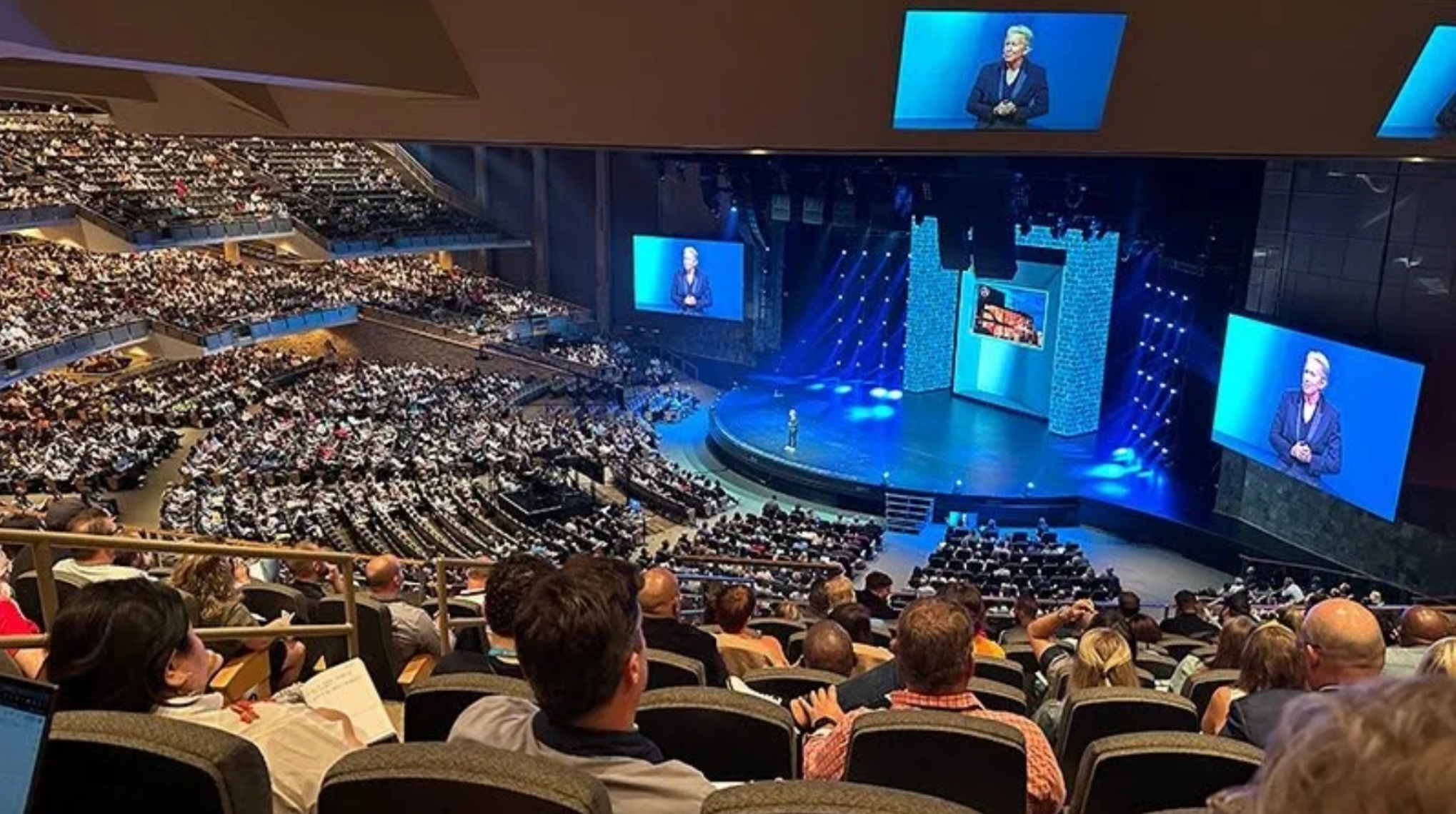
I just returned from the Global Leadership Summit this last week. An international event with more than 60,000 in attendance onsite and online in the US alone, the GLS is the biggest leadership experience in the world.
It was an insight- and inspiration-packed agenda, with speakers like former Secretary of State Condoleezza Rice, author of Atomic Habits James Clear (author of Atomic Habits), Anita Elberse (Harvard Business professor), Cynt Marshall (CEO of the Dallas Mavericks), Patrick Lencioni (best-selling author), Pat Gelsinger (CEO of Intel), and others.

Above: Investing in leadership at the Global Leadership Summit.
Over the past year, I’ve worked with the Global Leadership Network team, and it was a joy to be there live to go live with two new subscription products we’ve worked very hard on - Team365 and Leader365.
While I was there partially to see and support the team for the product launch, I was primarily there to invest in my own leadership.
I was reminded of the importance of getting away from the office, out of the day-to-day routine, learning and being open to new ideas, and being in community with other leaders.
💡 Takeaway: Do you invest in your leadership? Are you too busy investing in others? Do you step away from the work with no specific agenda to learn, be challenged and enriched?
In today’s Wave Report, I’d like to share some of the most impactful ideas and insights I took away from the Summit – insights that I think you might appreciate and be able to leverage in your leadership.
If you are interested in any of these insights and the accompanying talks and resources like discussion guides, illustrative talk summaries, and more, you can subscribe to Team365 or Leader365 for ongoing access.
Let’s dive in.
Lesson #1:
Everyone wins when the leader gets better.
– Craig Groeschel
Host of the Craig Groeschel Leadership Podcast and founder and senior pastor of Life.Church, Craig Groeschel best summed up the spirit of the GLS with this sentiment.
Everyone wins when the leader gets better.
It sounds cliche, but that’s because it’s true – leadership has an outsized impact on the performance of any team, initiative, or organization.
But more than that, Craig challenged the myth that “leaders” are only those at the top of an organizational hierarchy. Leadership is influence, he argued. If you have influence, you are a leader.
Lesson #2:
There are no victims. If you allow yourself to be a victim, you give your power to someone else.
– Condoleezza Rice
Former Secretary of State Condoleezza Rice grew up amidst difficult circumstances in segregation-era Birmingham, Alabama. She defied expectations to rise to help lead the nation at a critical time in history. She continues to equip leaders through books such as To Build a Better World and Extraordinary, Ordinary People, and as a director and professor at Stanford University and civilly engaged leader.
In urging leaders not to allow themselves to become victims, she went on to encourage leaders – “Own your past. Recognize that it has shaped you, but never become a prisoner to it.” So good.
Lesson #3:
Winning is about attitude and attention to detail.
– Anita Elberse
Harvard Business Professor and author of Blockbusters: Hit-making, Risk-taking, and the Big Business of Entertainment, Dr. Elberse talked about her research into creating winning teams with leaders of Formula One racing teams and soccer organizations like Manchester United.
She described how winning teams fostered a culture of “See it. Say it. Fix it.” Winning teams analyze mistakes, even when they are winning, and set the highest standards for everyone.
Above: Anita Elberse, professor at Harvard Business School and author of Blockbusters: Hit-making, Risk-taking, and the Big Business of Entertainment, shares lessons on shaping a winning culture from studying high-performance Formula One racing teams.
Lesson #4:
You can have a hard season and still be a good leader.
– Albert Tate
Albert Tate, founder and lead pastor of a multiethnic, intergenerational church in Los Angeles, encouraged leaders to “lead from where you are.” Not every day is a highlight reel, and a huge component of leadership is choosing to show up. Keep showing up.
Do you remember the movie Finding Nemo? Remember Dory’s line from the film? Just keep swimming, just keep swimming.
Tate exhorted leaders - just keep leading, just keep leading.
This might seem a little glib, but multiple speakers talked about the importance of persistence. Of showing up. Of the power compounding small actions over a long period. Which brings me to my most-anticipated speaker of the summit… James Clear.
Lesson #5:
Be the architect of your habits, not the victim of them.
– James Clear
In what was personally the most impactful talk of the Global Leadership Summit, author of Atomic Habits: Tiny Changes, Remarkable Results James Clear unpacked the power of habits and a process for developing them.
Habits are the compound interest of self-improvement. Time will magnify what you feed it. – James Clear
A 1% improvement every day for a year leads to exponential growth. A 1% increase each day, compounded, leads to a 38X impact over just one year.
You don’t rise to the level of your goals, you fall to the level of your systems. – James Clear
Too often, leaders focus on building healthy habits themselves. They start them and fall off. The trick is developing systems that lead to long-term health and impact.
By definition, your current habits are designed to lead to your current results. – James Clear
Ouch. This one hits home. If you want different results, change your habits.
Every action you take is a vote for the type of person you wish to become. – James Clear
Coming off of the sting of the truth from the last quote, this encouragement is that each better decision, each system developed, and each habit practiced leads step-by-step to the person you want to become.
Further, once you start to see yourself as the type of person who practices the habit in question – the more it becomes a part of your identity – the easier it becomes to stick with that habit. For example - the goal isn’t to read; it’s to become a reader. The goal isn’t to finish a race; it’s to become a runner. The goal isn’t to write a book - it’s to become a writer.
💡 Takeaway: Habits are the compound interest of self-improvement and are the necessary foundation for becoming who you want to be.
Lesson #6:
Design lives that prioritize connection and community. (None of us deserve perfect friendships because none of us are perfect!)
– Liz Bohannon
Liz Bohannon, the founder of Sseko Designs and author of Beginner’s Pluck: Build your Life of Purpose & Impact Now, talked about the epidemic of loneliness that we are experiencing in modern society.
She cites the recent Surgeon General’s declaration of a public health crisis, detailing the devastating impact of loneliness and isolation in the United States.
She gave three practical next steps for living a life of vulnerability, connection, and building community:
Go first.
Pay your dues (i.e., it takes time and commitment).
Practice reflective listening.
Lesson #7:
Diversity is being invited to the party. Inclusion is being asked to dance.
– Cynt Marshall
The CEO of the Dallas Mavericks, Cynt Marshall, told the story of being asked by Mark Cuban, the team’s owner, to help fix the organization’s culture.
Cynt had some powerful things to say about not just the impact of diversity but moving beyond that to the importance of inclusion in creating a thriving organization.
If diversity is about counting the numbers, inclusion is about making the numbers count. – Cynt Marshall
If diversity is the ingredients, then inclusion is the recipe. – Cynt Marshall
Let’s end with one of my favorite leaders, Patrick Lencioni.
Lesson #8:
Three types of courage – personal, public, and interpersonal.
– Patrick Lencioni
Patrick Lencioni is the Founder and CEO of the Table Group, creator of the Working Genius model, and author of books like The Five Dysfunctions of a Team and The Advantage.
Patrick spoke about the three critical virtues of leaders – wisdom, humility, and courage.
He talked about the importance – and increasing difficulty in the world today – of having courage. The willingness to say, “I don’t agree with that, and here’s why.”
He unpacked three types of courage:
Personal Courage - The ability to be consistent and hold to your values, even when no one else is looking.
Public Courage - The ability to speak up and be who you are in public.
Interpersonal Courage - The willingness to say hard things to another person in the context of a relationship.
I hope one or more of these lessons is a blessing to you.
Remember, if you’d like to learn more and see these talks over the coming weeks and months, subscribe to Team365 to see all talks immediately and share with your team, or Leader365 to get talks as they release each month, along with accompanying resources.
If this has been helpful to you, I highly encourage you to consider attending the Global Leadership Summit next year, in-person in Chicago or live at a host site near you. They are offering reduced rates for pre-registrations now.
Until next week… Surfs Up! 🌊
- Dave