
This week we hosted a summit here outside Seattle for a global nonprofit doing important work around the world. They came to us after several years of essentially flat recurring giving – and not for lack of trying. Over the last two years, they'd rebuilt their program and even renamed it. They'd been working hard.
What they didn't have yet was alignment and a roadmap.
This week, they got both. Over the course of a day together, we mapped 22 concrete opportunities to grow their recurring giving and put them in priority order. By the end, you could feel the shift in the room. They walked in cautious but hopeful. They walked out with a plan.
That's the thing about a stuck program. It almost never means the team isn't trying. More often, it's a team too close to the work to see the path forward.
If recurring giving has been a bright spot for your organization, you already know why it matters. Reliable, recurring revenue is the resource most nonprofits aspire to. And if you sense there's more potential in your program than you've been able to unlock, you are not alone.
We estimate that roughly three-quarters of charities have historically been left behind when it comes to building a strong, growing recurring giving program (The Rise of Sustainable Giving). But the ground has shifted. The subscription economy and changing donor behavior have made recurring giving more accessible to more charities than at any point in history. From 2023 to 2025, the average charity grew recurring revenue by 36.5% (From Neon One's 2026 Recurring Donor Report).
So if your sustainer program feels stagnant – or you've simply wondered whether there's more there – it doesn't have to stay that way.
In our work with charities, we see similar patterns emerge. When a program isn't growing, it's rarely about how hard the team is working – and it's rarely just one thing. There are other reasons a program can stall, but in our experience, here are nine of the most common we see:
Reason 1: You've hidden the program from your donors.
Many nonprofits treat recurring giving as a checkbox – an option once a donor has already decided to give a single gift. Beyond that, it's nearly invisible. Buried in communications. Rarely mentioned. Not prominent on the website. A passing line in new-donor onboarding. Outside of one annual push, it barely registers in the donor's awareness.
💡 Takeaway: Is recurring giving featured prominently, across every channel, year-round? Are you proud of your program – or is it treated as a secondary option to one-time giving?
Reason 2: You lack an ongoing value proposition.
The most common way organizations build a recurring offer is to take their best one-time ask and simply repeat it every month. The problem is, the best one-time ask is usually not a good recurring one. Recurring giving has to answer a different question: why does this donor need to stand with the cause on an ongoing basis – month after month, year after year?
💡 Takeaway: Have you made the case for why it's essential that recurring donors support the cause on an ongoing basis, not just today?
Reason 3: You don't have an internal owner.
Organizations often say they want to grow recurring giving, but no single person is responsible and accountable for making it happen. Outside partners are valuable (we're often one!), but growth needs a champion inside the organization – someone with the influence and the mandate to move it forward.
💡 Takeaway: Who owns recurring giving growth at your organization? There should be a clear answer, and it can't be "everyone." Nor should it be someone who owns it in name but lacks the influence or resources to act. The best internal owners are competent, eager to learn, and growth-minded.
Reason 4: Recurring giving isn't a priority.
Sustainable giving might be a priority for you personally – but not yet for the people whose buy-in you need. If decision-makers and budget-holders don't prioritize recurring revenue, it won't get the attention it needs to grow and thrive.
💡 Takeaway: Leadership has to place real priority on growing recurring giving, and that emphasis needs to trickle down through the organization.
Reason 5: You're focused on acquisition when you should focus on conversion (or vice versa).
Every program leans one of two ways. Acquisition brings in new donors who give on a recurring basis from their very first gift. Conversion moves existing single-gift donors onto recurring. If you put your effort against the wrong one, you waste significant time and resources.
Clues you should focus on conversion include: a solid existing donor file, a healthy flow of one-time acquisition, regular opportunities to be in front of donors, and a sustainer offer that takes a little more understanding and commitment.
Clues you should focus on acquisition include: a value proposition with broad appeal, a highly visible need, a clear and easily understood solution, and a cause that naturally justifies ongoing giving.
💡 Takeaway: Decide which growth path fits your organization – acquiring new sustainers or converting existing donors – and resource it accordingly.
Reason 6: You aren't using the right channels.
Not every channel works for every charity, and some are far better at certain jobs than others. When we advise clients, we evaluate 10 different areas and 17 different channels – some better suited to acquisition (A), others to conversion (C):
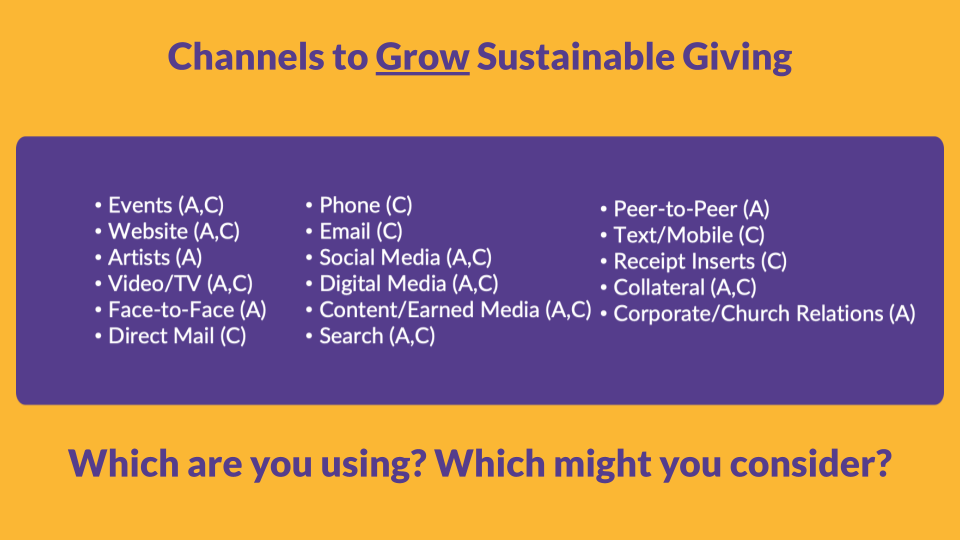
As you weigh channels, consider three criteria:
Scale: What is the potential reach of this channel?
Cost: What is the cost per new sustainer, and the overall investment?
Value: How valuable are these new donors over their lifetime (LTV)?
💡 Takeaway: Putting the right effort into the right channels is how you make the most of limited resources and attention.
Reason 7: You don't know your core metrics.
It's hard to know where you're going if you don't know where you are. Instrumentation and measurement are essential to understanding how your program is progressing. In my book, The Rise of Sustainable Giving, I outline 12 core metrics for organizations to track as they move from starter to advanced.
Here are the first four to watch every month:
Total active recurring donors
Total revenue from recurring donors (all sources)
Recurring donors as a percentage of total revenue
Lifetime value (LTV) of recurring donors
💡 Takeaway: What gets measured gets prioritized. Measurement tells you where you are – and motivates you toward where you want to be.
Reason 8: Your technology is holding you back.
Technology is an easy scapegoat for "we can't do that," when the truth is there's almost always a workaround. But sometimes the constraint is real. I've worked with organizations that couldn't even identify their recurring donors in their CRM, and others whose sign-up process was so convoluted it actively discouraged donors from enrolling.
💡 Takeaway: Ask of your technology: is this serving our sustainer program today – and will it still serve us when we're 10X our current size?
Reason 9: You haven't built an actual program.
Coming full circle: for many charities, recurring giving is still just a checkbox. A gift type in the CRM. But it isn't yet a program that's genuinely compelling to current and would-be donors. A holistic recurring giving program is more than a strong offer and an ongoing value proposition. It also has a clear brand identity, meaningful benefits, and a dedicated presence.
💡 Takeaway: A real sustainer program is built on a strong offer, an ongoing value proposition, a clear brand identity, benefits, and a dedicated presence.
The good news
Here's what I want you to take from the charity we hosted this week: a stuck program isn't a foregone conclusion. It's an opportunity – to stop doing more of the same, look at things with fresh eyes, and try a different path. Because just working harder isn't enough. We had to see differently.
Every one of these nine reasons is fixable. And when you can see the specific reasons your program isn't growing – and a prioritized path through them – growth stops feeling impossible and starts feeling like a plan. That's what changed in the room this week. Not the team's effort. Their clarity.
The potential in your program is almost certainly greater than what you've realized so far. The work is in seeing it clearly, and then moving.
Until next week… Surf's Up! 🌊
– Dave
P.S. The work we did with that nonprofit this week – an honest assessment of where their recurring giving stands, and a prioritized roadmap to grow it – is the heart of the Sustainable Giving Growth Advisory work we do with charities. It's built for organizations with an established base of recurring donors who sense there's more potential there. It isn't the right fit for everyone, and that's okay. But if you read these nine reasons and recognized your own program in more than a couple of them, it may be worth a conversation. You can learn more at sustainablegiving.org/grow.