
Generosity from Generation to Generation
I'm a geriatric millennial.
I promise that's a real term, and I promise I'm not making it up to get a laugh (though it got one out of me the first time I heard it). Born in 1981, I'm just barely a millennial – older than most of my millennial counterparts and only a couple of years shy of being a Gen Xer.
The term “geriatric millennial,” popularized by author Erica Dhawan in 2021, describes those of us born between 1980 and 1985, a micro-generation that straddles the digital divide. We remember a world before the internet, and we adapted to the one after it. One advantage of being elder millennials is that we can bridge the communication styles of the generations on either side of us.
These days, that bridge runs right through my own house.
My eldest daughter just turned 16. She was born in 2010, which places her squarely in Gen Z. My youngest daughter is 13, born in 2013, which makes her Gen Alpha. So I’m not just interested in the topic of generational change – I'm raising two generations of it under one roof.
And here's where the geriatric millennial dad and the guy who thinks about generosity all day collide – I find myself asking a question I suspect every parent eventually asks in one form or another:
Will the next generation be as generous?
It's an easy question to worry about. This generation has more abundance, more access, and more distraction than any generation before it. If you squint at the headlines, it's tempting to assume the kids are too online, too self-focused, too busy to care.
I recently read two studies that changed how I think about that question. One is about whether the next generation is generous at all. And the other is about how generosity gets passed from one generation to the next – and what we, as parents and as charity leaders, can actually do about it.
Let's start with a look at Gen Z and generosity.
The Next Generation Is More Generous Than You Think
GoFundMe and GivingTuesday teamed up on a report about Gen Z and generosity, and the headline is more encouraging and surprising than I would have expected:
Gen Z is more generous than you think.
A few of the findings that stood out:
They show up. 71% of Gen Z gave in some form in the past week, compared to 65% of other adults. They were also more likely to give money, 43% versus 39%, and they did it despite being more likely to have lower incomes, be students, or be between jobs, simply because of where they are in life.
They're multipliers. Gen Z is more likely than older adults to:
💟 Advocate for causes (+13 percentage points),
💟 Give informally (+11 points)
💟 Volunteer (+10 points)
💟 Share and encourage others to give (+8 points)
Crowdfunding is a gateway, not a substitute. They give to others through crowdfunding, and it’s correlated with their participation in charitable giving.
91% of Gen Z crowdfunding users also gave to registered nonprofits – 16 points higher than their older counterparts. The GoFundMe generation isn't giving instead of supporting charities. They're doing both.
In other words, the generation we quietly worry about is giving, donating, volunteering, advocating, and bringing their friends along with them.
That’s encouraging. 💜
But there's one finding that matters more than all the others for what comes next.
They trust the people closest to them. 57% of Gen Z say that family or others in their immediate network shape their giving decisions, compared to 43% of other adults.
Which is exactly the thread that leads into the second study.
💡 Takeaway: The next generation isn't a generosity problem to be solved. They're generous, they're vocal about it, and the biggest influence on how they give is the people closest to them – starting with their parents.
Speaking of parents, let’s look at the next study, about the influence of upbringing on passing generosity from generation to generation.
Generosity Is Passed Down
The second study is called Raising Givers: Passing Generosity from Generation to Generation, from Ron Sellers and the team at Grey Matter Research. If the Gen Z report answers whether the next generation gives, this one answers how that generosity gets transmitted in the first place.
The big picture from surveying more than 1,100 non-profit donors is this:
When donors grew up seeing their parents model, talk about, and encourage generosity, they became dramatically more generous as adults.
Consider just a few of the insights from the study:
Setting an example inspires generosity. Those who very frequently saw their own parents supporting nonprofits give twice as generously as those who rarely/never saw giving modeled.
💟 60% higher giving to support nonprofits (median amount)
💟 100% higher proportion of income donated to charities
Generosity begets generosity. Today’s donors give more money and a higher proportion of income when they frequently saw their parent(s) supporting charities.
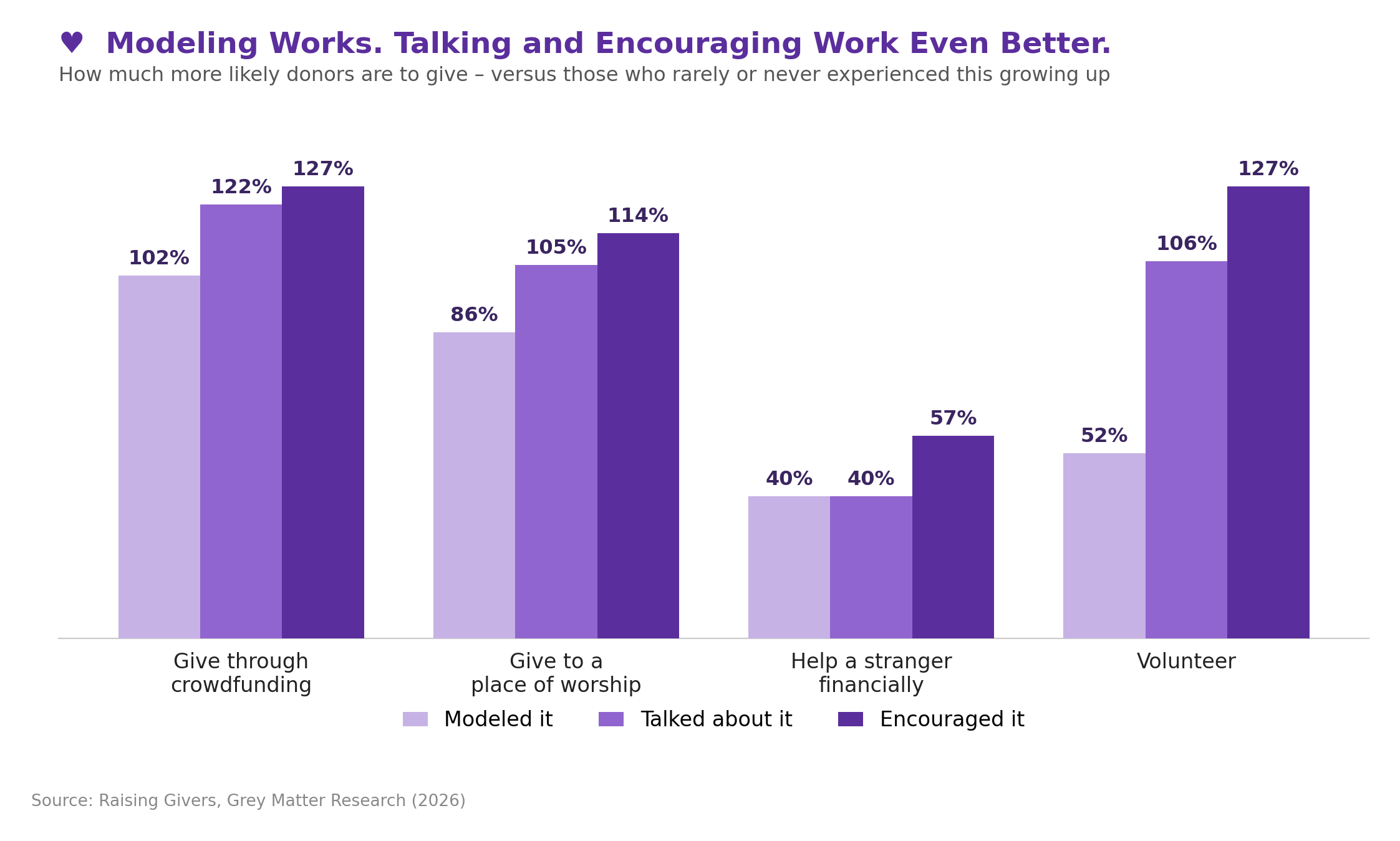
💟 102% more likely to give to an org through crowdfunding
💟 86% more likely to give to a place of worship
💟 40% more likely to help a stranger financially
💟 52% more likely to volunteer
Don’t just model generosity – talk about and encourage it. Setting an example through giving is one thing, but the real power comes in talking about it with children, and even better, encouraging them to be generous. Here are the differences between people whose parents modeled generosity, those who frequently talked about it, and those who encouraged them to give, even as children:
Generosity carries from generation to generation. Donors who grew up in a generous household are far more likely to model giving behavior for their own children.
💟 62% higher frequency of giving while raising their children.
💟 91% more likely to explain where and why they gave.
💟 96% more likely to encourage their own children to give.
Generosity, it turns out, can be passed down and grow from generation to generation.
💡 Takeaway: Generosity isn't random, and it isn't automatic. It's transmitted. The most reliable predictor of a generous adult is a childhood spent around generous, giving parents.
I think about how my parents modeled, talked about, and encouraged generosity in me, and how that has shaped our family today.
My Own Heritage of Generosity
This insight rings true because I’m blessed to have come from multiple generations of generosity. I can distinctly remember the generosity that my grandparents exhibited, whether it was Grandpa Virgil sharing at the breakfast table about individuals and organizations they were supporting, or Grandma Maxine playing her accordion at senior homes.
And I have vivid memories of my parents modeling generosity, writing a check to the church or giving to help a homeless man. But they also talked with me about it and encouraged me along the way, whether serving at an orphanage in Mexico, giving to support a project, or volunteering at a rescue mission in LA.
A year and a half ago, I wrote a Wave Report asking, "Are We Teaching Generosity to Our Children?" It focused on my two girls baking French macarons for a human-trafficking fundraiser they called Patisserie for Freedom. I made the case, as a dad, that we have to make generosity visible, normalize it, and celebrate it.
I believed all of that then. We just didn't have the research to back it up.
Now we do, and the question is: what are we going to do about it, as parents and as nonprofit leaders?
The Role We Can Play
I’m so encouraged that the data from GoFundMe and GivingTuesday shows us that the next generation is generous. We have an opportunity to help shape that generosity.
If you are a parent, a grandparent, an auntie or uncle, a mentor, or a charity leader, you have a role in inspiring generosity in the next generation.
Don't just give where your kids can see it. Tell them who you support and why. And invite them in – let them pick a cause, make a gift, serve alongside you. Do it often enough that it becomes ordinary.
My girls have inspired me. Our eldest gives to a charity called Atlas Free every month, and my youngest gives to Atlas Free, the Kitsap Humane Society, and both give to our church and another charity called Summer in the USA.
I'll be taking my own advice. Keep modeling generosity, keep talking about it, keep encouraging it, and keep making it a normal part of who we are as a family.
But if you lead a charity, this study is about far more than your own kitchen table.
For years, the loudest conversation in our sector has been about chasing younger donors – how do we reach Gen Z, how do we win the next generation before someone else does. Raising Givers points to a quieter, more powerful idea: many organizations are chasing younger donors. Imagine what could happen if you helped develop them instead.
The study's closing questions read almost like a brief for the next great donor-engagement idea:
Do you help the parents and grandparents in your file foster generosity in their kids?
Do you offer talking points, or child-friendly materials, or ways to explain hard causes – poverty, trafficking, illness?
Do you encourage holiday gift-giving to help parents give a gift in order to build generosity in their own children – and what might you send the child that’s actually designed for them?
Is there a place on your website where a kid can explore and learn what you do?
There's a beautiful, low-tech version of this that development people have known about for decades: the sponsored child's photo on the refrigerator.
Grey Matter notes they've heard countless stories of adults who sponsor a child today because they grew up with a sponsored child's picture on the fridge and letters arriving in the mail. No campaign. No ask. Just a small, repeated, visible act of generosity that a child absorbed and carried into adulthood.
That's the opportunity here. And it reframes something I believe deeply: donors are not ATMs. Generosity is not just pulling out your wallet. When we help a family raise a generous child, we're not running a campaign – we're inspiring the next generation of generous humans.
💡 Takeaway: The next generation of donors isn't only out there to be acquired. Some of them are at the dinner tables of the donors you already have. Help those parents raise givers, and you're not chasing the future – you're building it.
When my girls hit their fundraising goal a year and a half ago, my wife and I were just as thrilled as they were. We didn't hold back. It was a highlight for the whole family.
I think that's the part the research can't fully capture in a percentage. Generosity feels good. And when our kids feel it – really feel it – something takes root that no appeal letter could ever plant.
Parenthood is a gift. Generosity is a gift. And the chance to pass one along through the other might be the best gift of all. 💜
I hope you're inspired to participate – and to pass it along.
Until next week… Surf's Up! 🌊
- Dave