
Growing Hearts and Growing Generosity Globally
Have you ever had a moment where your heart was so moved that it ached? Not the ache of pain or brokenness alone – but the ache that comes from growth. Suddenly there is more room. More empathy. An expanding world. An expanding purpose. An expanding perspective.
This past week, I had two such moments – one of grateful remembrance, and one of collective generosity. Two moments where my heart grew.
The first was a reunion. Ten years ago, in Jakarta, Indonesia, I joined more than a thousand younger leaders from over 150 countries for the Lausanne Movement's Younger Leaders Gathering – a gathering designed to connect and equip emerging young leaders (yes, indeed, at one point I was considered “young”).
I came away from that gathering changed – with friendships around the world, and a desire for global impact. This past week, we gathered on the 10th anniversary to remember and celebrate. And I was reminded that my heart for global generosity has been growing for a long time.
The second is the one I want to reflect on with you for the Wave Report this week: The Greater Giving Summit.
Convened in Atlanta by the team at GivingTuesday and made possible by the Gates Foundation, the Greater Giving Summit was designed as "a space to step out of parallel work, speak honestly, and build stronger connections across the giving ecosystem." It brought together leaders and organizations from every corner of the sector – including some corners I didn't even know existed.
I was grateful to be in the room with influential leaders from across the ecosystem – researchers, funders, technology providers, thought leaders, platforms, fundraisers, and philanthropic advisors. And I have high trust in the GivingTuesday team's intentions and their gift for bringing people together.
What struck me most was the sheer range of people who have given their lives to generosity, and the many forms it takes. Some standout examples include:
Guillermo, who is facilitating generosity across South America, Europe, and globally at the UN.
Sue, bridging research and practice in volunteer engagement.
Yosef, writing a PhD dissertation on sustainably funding cultural institutions.
Tyeshia, helping people see themselves as philanthropists through collective giving.
Eleni and her colleagues, using behavioral science to inspire generosity.
Danielle, researching the growing donor-advised fund (DAF) giving ecosystem.
Armando, Floyd, Heather and others, shining a spotlight on Black, Latino, and other minority-led charities.
…and so many more. 💜
Each one a different doorway into the same big room of generosity.
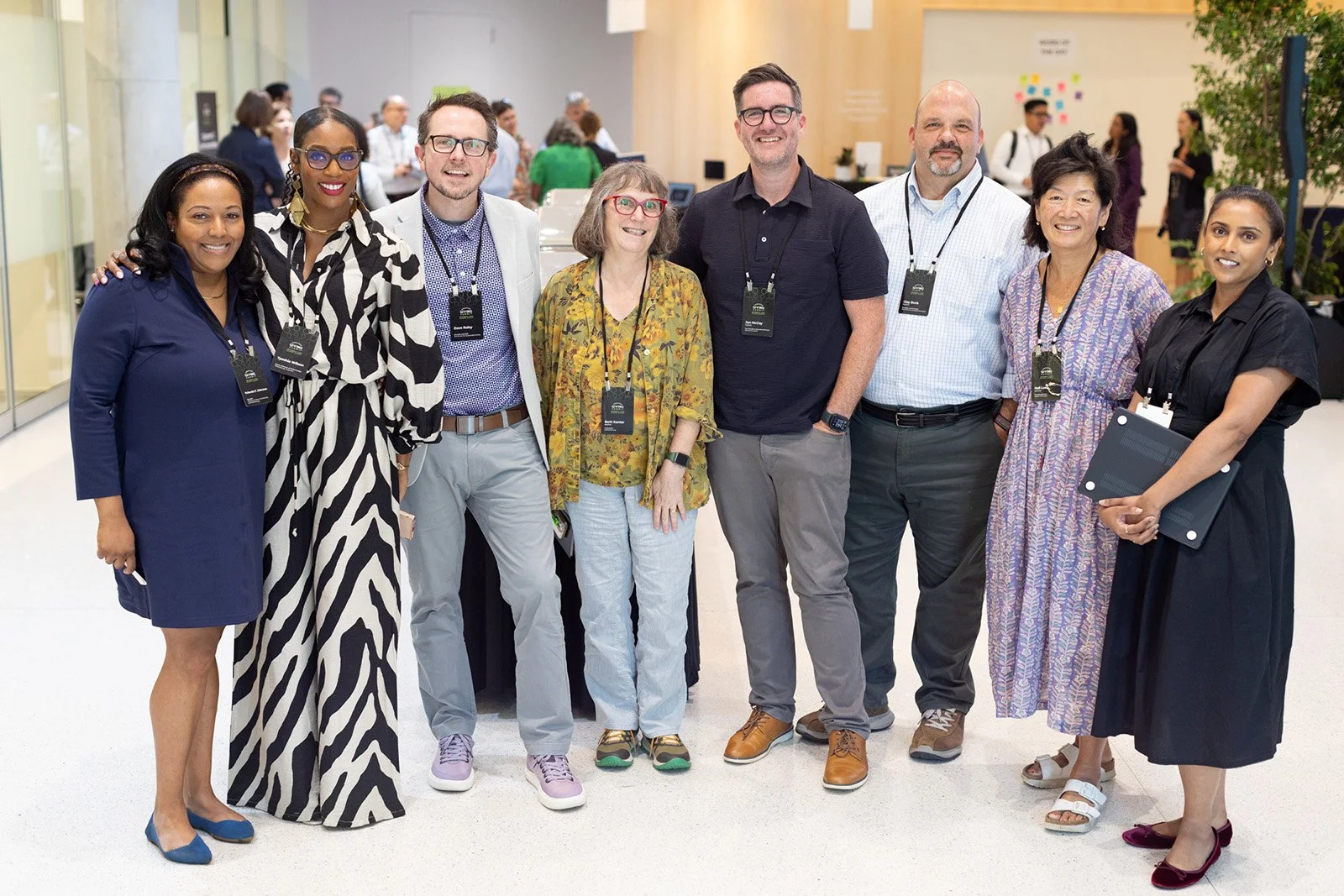
With fellow thought leaders at the Greater Giving Summit, a group of curious connectors and curators – writers, talkers, ranters, weavers, believers, and doers. (Photography by Kennedy Carey)
I'm a big believer in the concept of the "strength of weak ties." In social theory, weak ties are the casual connections and loose acquaintances outside your core circle. And that's exactly why they're so valuable, because they're the ones most likely to introduce you to ideas and connections that will expand your heart and mind.
As Stanford sociologist Mark Granovetter, who led the groundbreaking research on this in the 1970s, put it: "Your weak ties connect you to networks that are outside of your own circle. They give you information and ideas that you otherwise would not have gotten."
The Greater Giving Summit this past week was a living example of the strength of weak ties for me.
Reflecting on the time, I was left with three overarching themes:
Generosity is for everyone
This was the most consistent theme of the week. Giving is for everyone – but it's unevenly distributed. As GivingTuesday CEO Asha Curran put it, how do we make generosity easier to find, harder to lose, and more available to millions of people?
Generosity is bigger than the tax code. It won't be constrained by narrow definitions. It extends well beyond tax-deductible donations, and beyond simple monetary giving – and we have to be careful not to let what's countable become the only thing that counts.
Generosity isn't scarce – it just isn’t accessible. People are generous, but they need opportunities and invitations to act. In the U.S., fully half of Americans could not recall being asked to give. Among those who were asked, 87% gave. Americans are generous, if asked.
Continuing the global theme, the Charities Aid Foundation (CAF) World Giving Report found that, when looking at giving as a proportion of income, the most generous nations are Nigeria, Ghana, Egypt, Kenya, and India (the U.S. ranks #57). When looking at the percentage of the total population that gives, the most generous nations were Ireland, the Netherlands, UAE, Vietnam, and the UK (the U.S. ranks #36).
People are generous. They need to be invited to participate.
Generosity grows where we connect
Some of the richest insights didn't come from a stage – they came from the people in the room, and from what happens when you gather very different people in one place. Generosity doesn't grow in isolation. It grows in the connections between us.
We need more third spaces in the generosity ecosystem. The sector needs more places to get outside our niches and bubbles – to come into contact with what philosophy calls “the Other.” The Other represents anything that is perceived as different from oneself – a different kind of person, organization, region, age, language, or belief system. Connecting with Others is where we cultivate what I call an Open Mindset – a sense of curious observation paired with a powerful imagination – and it's the intersection where real creativity and innovation can take place.
The language of generosity is inconsistent. In 22 years in this sector, I've never heard so many divergent terms in three days, including some I’ve never heard before. “Everyday giving,” “collective giving,” “grassroots generosity,” “civil society,” “financial inclusion,” “social sector.” Each corner of the sector seems to have its own dialect of generosity. Who's doing the work of translation?
Thought leadership matters – even if no one likes the term “thought leadership.” Across the ecosystem, curious connectors and curators play a key role in spreading awareness and building belief, and I’m honored anytime I’m counted among them. They write, talk, rant, weave, build belief, and get stuff done. They are holding the collective microphone for the sector, amplifying what they see – which is why it’s so important for the researchers, practitioners, and so on to be connected with them.
Inspiring generosity takes diversity – and unity. I couldn't imagine a more diverse group gathered for one purpose… to inspire generosity. We came together from different backgrounds and diverse perspectives, approaches, political persuasions, beliefs, languages, ethnicities, and lived experiences, but unified by one thing – a desire to see generosity grow.
Generosity grows when we get outside ourselves.
Transformation takes belief – and space
Beneath the conversations about platforms, research, and strategy ran a deeper current – how does real change actually happen? Again and again, the week pointed to the same answer.
Crisis is the mother of innovation. Professor Tyesha Maddox and others described how crisis can become the fuel for transformation. I like to put it this way: if necessity is the mother of invention, then crisis is the mother of innovation.
We have to create space for transformation. Each of us has a role in making room for it – a leader who holds space for their team, a funder who gives a grantee runway to try something new, any of us who choose to believe in someone before they've proven it.
Belief precedes growth. Action does not happen without belief. Belief does not happen without hope. Hope does not happen without awareness.
In this ecosystem, we have the opportunity to be belief-builders.
As I reflect on this past week, I'm grateful.
Grateful for the invitation.
Grateful for the connections.
Grateful for the insights.
Grateful for the inspiration.
Grateful to be a part of this big world of generosity.
We all have a role to play in creating the spaces and invitations to generosity.
What about you?
The beautiful thing about these moments is you don't have to "be in the room" for them to impact you. I've been moved in other times and other places by experiences others have had, that they invited me into simply by telling me about them.
So I invite you to reflect – what does generosity mean to you?
A few questions for you to consider:
Where might you step outside your usual circles – into a "third space" where you'd meet people, ideas, and organizations different from your own?
Who in your world is already generous but simply hasn't been asked – and what would it look like to offer the invitation?
Whose growth could you choose to believe in, and make space for, before they've proven it to you?
My heart grew this week – and I hope in some small way that yours does, too.
Until next week… Surf's Up! 🌊
- Dave