
If there is one area that has seemed in constant change the last few years, it's been the world of work. The discourse about remote work, hybrid work, gig work, quiet quitting, generational differences, and the state of work in general.
I regularly hear from clients and leaders about the struggle with finding and keeping talent, setting culture, and challenges to driving innovation and growth.
But how much has the world of work changed, if at all?
A new study, State of Workers 2023, just released, sheds some light on the topic from the perspective of U.S.-based workers.
I've written previously on leveraging hybrid and remote work in 2023, calling out key lessons we can learn from the 2022 edition of the Morning Consult study.
Conducted in January of this year, several things in the research stand out to me, reviewing what has changed – and what has stayed the same year over year.
Let's look at five key insights and lessons we can apply.
A similar number of workers quit recently or started a new job, but fewer are contemplating a change, indicating some settling.
Individuals are quitting current jobs and starting new jobs at a similar pace – 27% in January 2023 vs. 29% in January 2022. But, the percentage of adults interested in leaving their current job is down from 43% to 34%.
All top employment considerations declined in importance to potential job seekers. The authors believe this signals a shift in workers' mentality – last year, workers could be pickier about their place of employment and the benefits that came with it.
The top considerations are:
Offers competitive pay
Has a good vacation/PTO policy
Supports a healthy work-life balance
💡 Takeaway: A shifting workforce is part of the new normal – recognizing turnover is a reality, what can you do to set up systems and processes to more effectively and quickly onboard talent and distribute work?
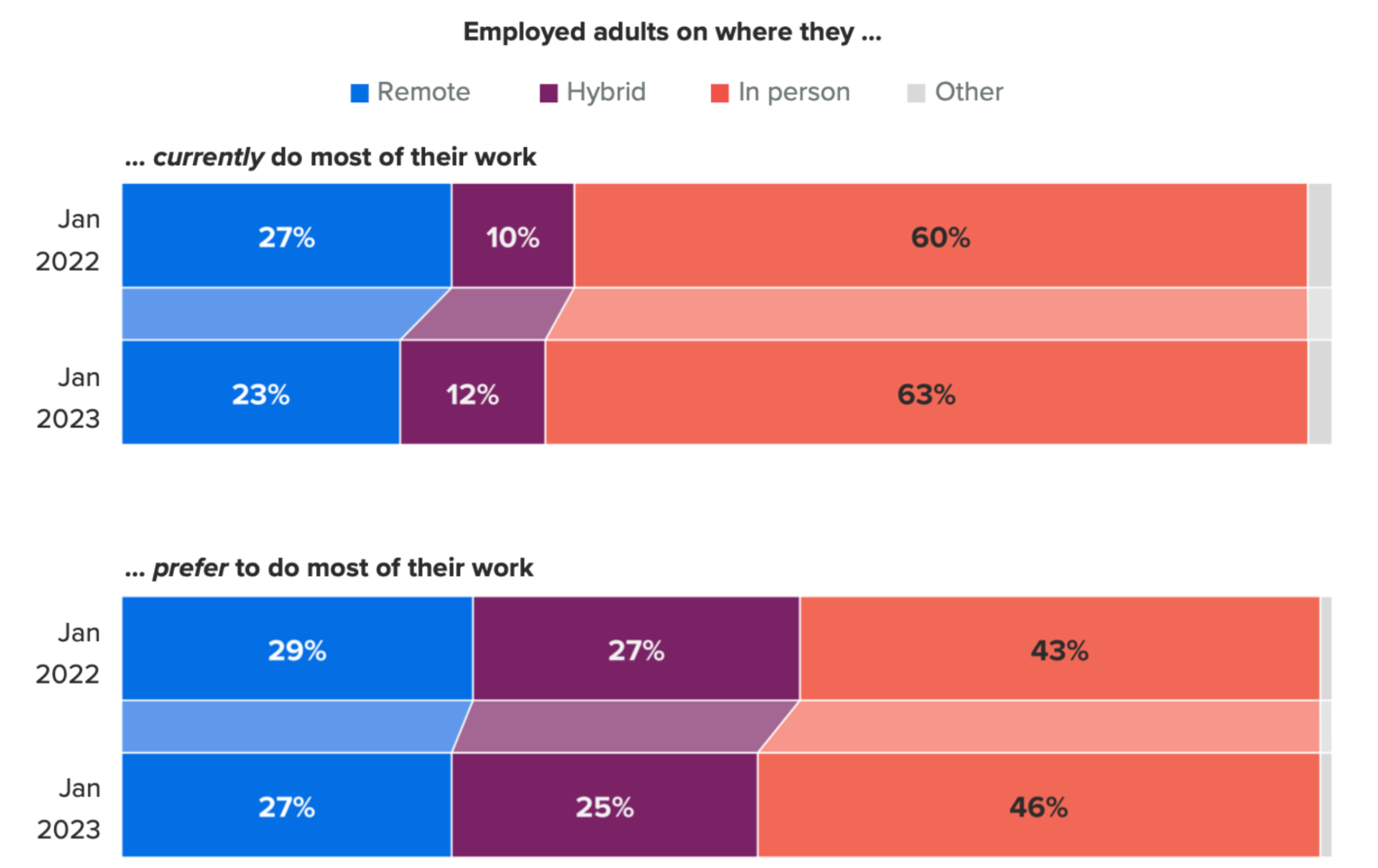
Full-time remote work is declining, but hybrid is growing - and is preferred by one-quarter of the workforce.
Fewer people work primarily remotely (down from 27% to 23%), while hybrid work has grown (up to 12% from 10%). But what struck me is that more than twice as many workers would prefer to work hybrid than currently are doing so (25% vs. 12%).
💡 Takeaway: Leading hybrid work is a skillset that will be critical for leaders and teams in the coming years. How can you leverage hybrid work to maximize the effectiveness of your people and improve employee satisfaction?
While the benefits of remote work are largely personal, there are two exceptions.
Most of the benefits cited for working remotely were personal in nature, such as focusing on caregiving responsibilities, maintaining a healthy lifestyle, and spending time with family and friends.
However, workers noted two notable work-related benefits when they work remotely: producing high-quality work and staying focused on work/being productive.
At the same time, it's important to note that when asked why individuals preferred in-person work, the number one answer was "I am more productive." Gen Z also showed the strongest overall preference for working in an office. This might be due to the type of jobs that younger people have. One hypothesis I have is that younger staff that are newer to the world of work benefit more from professional development and opportunities for social connection. More on that in a moment.
💡 Takeaway: If our people feel they can better produce more high-quality work and stay focused better working remotely, are there things you can do to your in-office culture, setup, and norms to enable your people to do so at the office?
Bonus: Remote work and in-office work come with tradeoffs
While not explicitly covered in the research, a recent study showed some interesting findings on the tradeoffs of work done remotely versus in the office.
The Power of Proximity: Office Interactions Affect Online Feedback and Quits, Especially for Women and Young Worker (Emanuel, Harrington, Pallais)
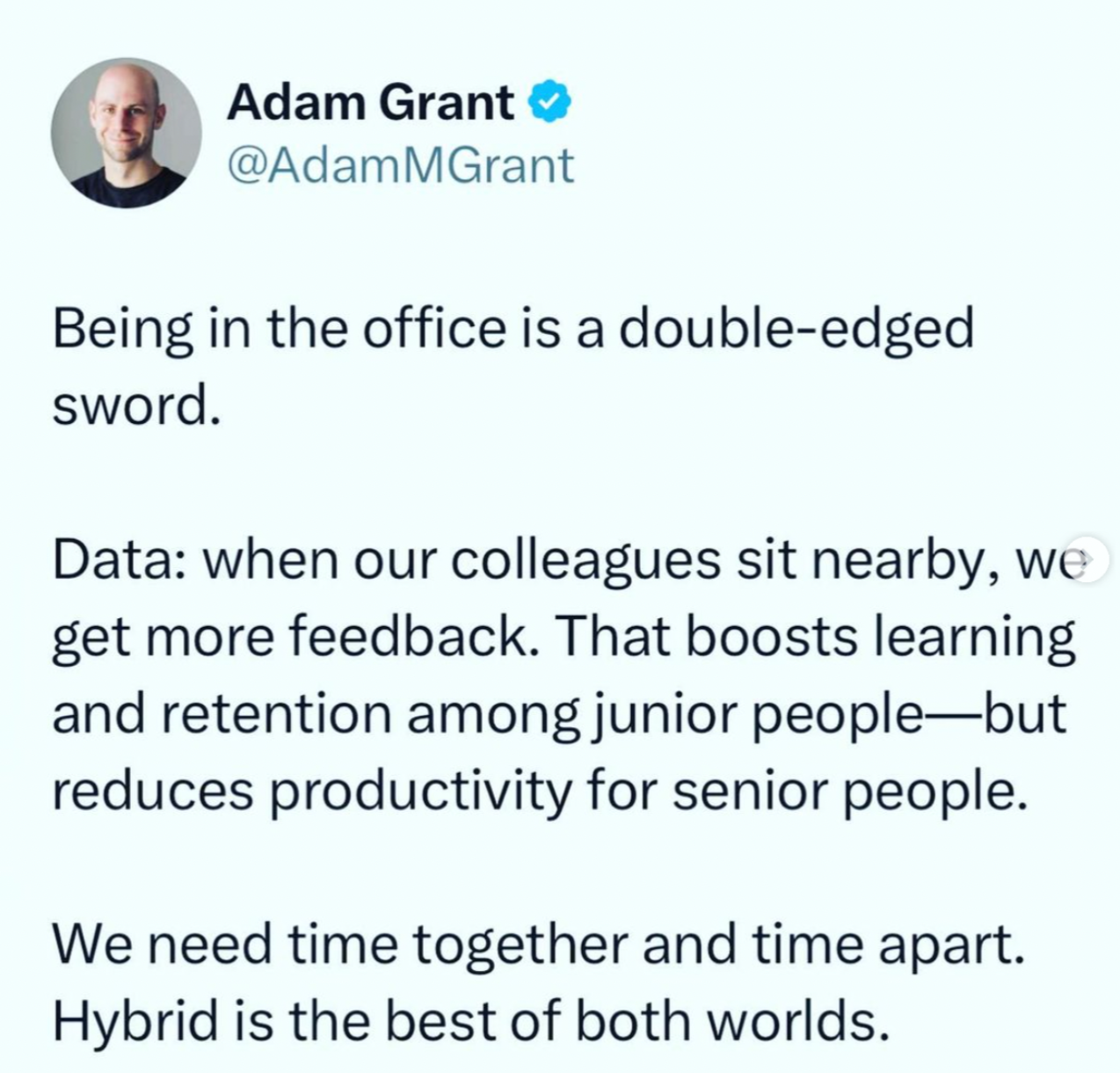
If you don't have the time or inclination to wade through a 105-page study, organizational psychologist and professor at the Wharton School Adam Grant summarized it well:
If you want a little more context, The New York Times recently did a piece on the study:
What Young Workers Miss Without the 'Power of Proximity' (N.Y. Times)
Caveat – this is just one study, focused on remote versus in-person work for engineers at a large technology company, so we have to be careful to generalize the results. While more studies will be needed to learn more generalized trends, the findings do ring true:
Proximity increases feedback and training, and aids people-development.
Proximity can decrease productivity, particularly for senior or more experienced people.
Two words that changed my relationship to change.
I'll never forget what my friend Rory said to me one bright sunny afternoon in July 2010.
We were expecting our first child the following month. Rory was a senior executive at our company and had become somewhat of a mentor to me by that point, an "up-and-comer," as the kids say (do they say that??).
I was running the digital division at the time, and with a first child on the way, I was eager to soak up any parenting advice I could get my hands on.
We were chatting and came around the topic of kids and parenting. That's when he hit me with it.
"Two words, Dave."
Rory said he had just two words of advice for me.
"Dave, I have two words for you. New. Normal."
New. Normal. New normal.
In just two words, Rory was trying to adjust my expectations – about parenthood, life, and marriage. Don't assume everything will be the way it was.
In my naiveté, I thought, "Okay, good to know, so I'll go from one 'normal' to a 'new normal,' and then things will be the same. Life before kids, and then life after kids. Pretty simple, right?
What I didn't know on that sunny day in July was that the "new normal" was a new, constantly changing reality.
Wrong. What I quickly realized – and if you are a parent, you already know where this is going – 'new normal' really meant new normals. Like, constantly. I remember feeling that every week – sometimes every day – brought new patterns, new normals to adjust to.
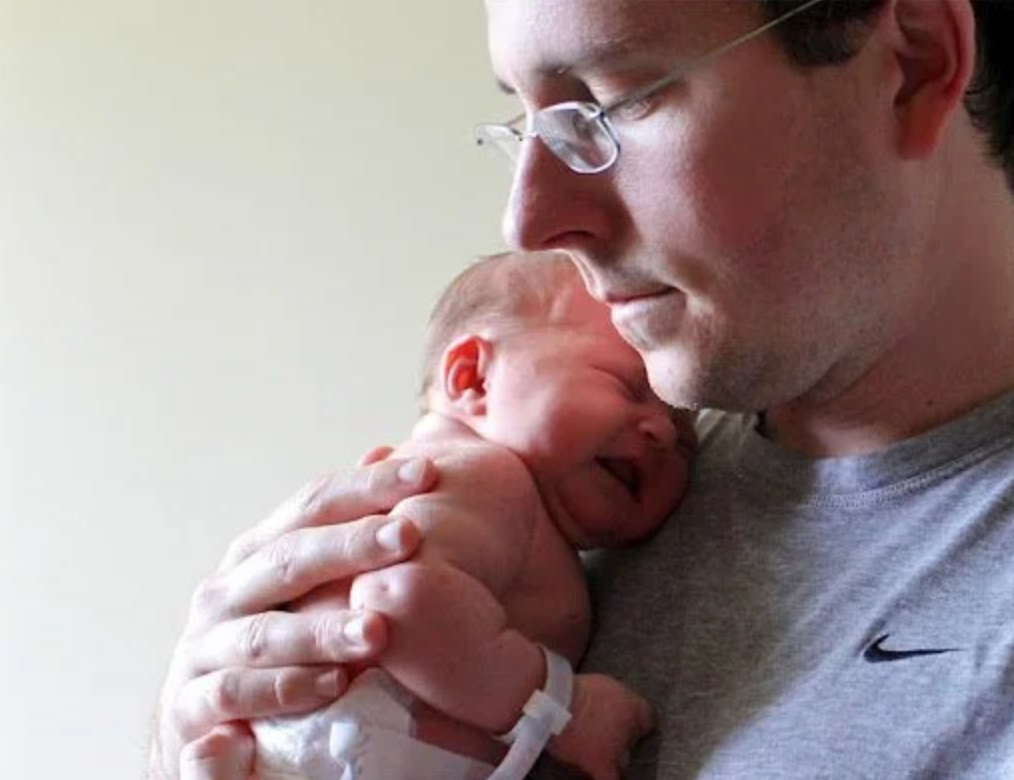
Above: My first day as a parent – proud and in love, with very little idea of the new normals to come. Parenthood is a series of new normals. How might we apply the lessons of flexibility and adaptive leadership that parents learn to our leadership today?
Today, 13 years later, a lot of life feels surrounded by new normals. Change. Needing to continuously adapt and learn and grow.
If you think about it, you and I have also lived through hundreds of other changes – many new normals. Some may be very personal and specific to your life situation. Others, like the emergence of remote and hybrid work, have become a shared new normal. We are all learning to adjust. And ideally, we are learning how to leverage the new normal. To thrive.
So, I pass along my two words of advice – a variation on those two words that Rory blessed me with all those years ago on that sunny day in July.
New normals.
Here's to what's next! 🌊
- Dave