
Your Best Recurring Offer Isn't an Object
When it comes to designing the best offer for recurring giving, one of the most important insights I've learned is this: focus on outcomes, not inputs.
I learned it the hard way – from a monthly giving program that looked perfect on paper but proved ineffective and frustrating.
The Program That Should Have Worked
My first job out of college was at an agency that specialized in fundraising for nonprofits, and my first client was Union Rescue Mission in Los Angeles – one of the largest social service charities in the country and the oldest mission in L.A.
When I arrived, URM had a monthly giving program called Meal-A-Day. The logic behind it was beautiful. The Mission's strongest single-gift offer was a hot meal and a place to sleep. A meal cost a little more than a dollar to provide. So for about $30 a month, a donor could give a meal a day, every day, all month long.
Think about how clean that is. The math works. The offer is concrete. It maps perfectly onto what the Mission actually does. If you were designing a monthly program in a conference room, Meal-A-Day is exactly what you'd land on. It's what I would have landed on.
There was just one problem. It wasn't working.
By the time I came into the picture, the program was stuck. Fulfillment – the percentage of donors who actually sent in the gifts they'd committed to – was abysmal compared to other charities. Churn was high. Growth had flatlined. The whole program represented less than 5% of the Mission's fundraising.
We eventually turned it around. But before I tell you how, I want to talk about why a program that made so much sense on paper struggled so much in practice – because the same trap is waiting for almost every charity reading this.
We Had Object-ified the Offer
You've probably heard the word objectify used to describe the opposite of this – treating a person as an object. Reducing someone with a name and a story down to a thing.
What I've come to believe is that many charities do a version of this to their own offers, in reverse. We build the offer around the object instead of the life behind it. We ask donors to fund the meal, the bed, the well, the unit of delivery – and in the process, we lose sight of who, or what, the gift is actually for.
Call it object-ifying the offer.
It's an easy mistake to make, and an honest one. But here's the heart of it: donors don't fund inputs. They fund outcomes. They don't lie awake caring about a meal – they care about what that meal changes: the person who was hungry and now isn't. The moment your offer is about the thing instead of the outcome it creates, you've put distance between the donor and the very reason they gave.
Why Objects Don't Stick
Here's the part that took me years to understand, and it's the key to this whole issue: object-ifying your offer isn't always a problem.
In single-gift fundraising, a concrete object offer is often your best play. "Give $30 and provide a meal and a bed tonight" is clear, tangible, and effective. I'd never talk a charity out of it for a one-time ask.
But recurring giving runs on different fuel.
A one-time gift is a moment. A monthly gift is a relationship – and relationships need something to hold onto month after month, year after year. Objects don't give donors that. Objects aren't sticky.
When your monthly gift buys a thing, canceling is easy. Nothing is really lost; you were funding inventory. But when your monthly gift is tied to a life you've come to know – when you've seen the face, followed the story, felt the connection – canceling feels like walking away from a person. That's the emotional hook that keeps sustainers giving for the long haul. You don't get it from a meal. You get it from a mom and her son.
💡 Takeaway: An object offer can win a one-time gift. It rarely sustains a recurring one. Objects aren't sticky – lives are.
Why Good Charities Fall Into It
If this is such a natural mistake, why do so many thoughtful organizations make it? In my experience, it comes down to three reasons.
Internal Focus
Sometimes we're simply in love with how we do our work. We're proud of the process, the logistics, the machinery of impact – and understandably so. But donors didn't fall in love with your process. They fell in love with your outcome. (This is a close cousin of a mistake I've written about before –confusing your model with your mission.)
Structural Distance
Sometimes there's real distance between the organization and the people it ultimately serves. I've worked with charities whose primary activity is building radio towers, or trucking goods across the country, or producing and broadcasting content. When your day-to-day work is a tower or a truck, it feels natural to talk about the tower or the truck. But the tower isn't the point. The person on the other end who finally hears a message of hope – that's the point.
Language Habit
This is the one I think is most common, and the good news is it's also the most fixable. It's simply the language we default to. "Sponsor a bed." "Sponsor a meal." "Fund a unit." We reach for the object because it's easy to name and easy to price – not because it's what moves donors. The fix costs nothing: stop naming the unit, and start naming the outcome.
What to Do Instead: Humanize the Offer
So when you're designing your best offer for recurring giving, the guiding principle is this: focus on outcomes, not inputs. And the most powerful way to do that is to humanize the offer – to connect donors, in an honoring and privacy-sensitive way, to the actual lives their giving is changing.
No matter what your charity does, there is a human outcome at the end of it. Find it. Name it. Put a face on it.
(And if the ultimate outcome of your work isn't a person – if you rescue animals, or restore a river, or protect a wild place – the principle still holds. Give donors the specific animal, the particular stretch of habitat, the community downstream. The rule was never "always talk about people." The rule is always talk about the outcome, never the unit.)
How We De-Object-ified the Offer at Union Rescue Mission
That's exactly what we did at Union Rescue Mission.
We stepped back and looked at who was actually walking through the Mission's doors – and the face of homelessness in Los Angeles had been changing. More than half of the guests were now women, children, and families, often pushed across the line into homelessness through no fault of their own.
They were people like Sarah and her son Elijah. (I've changed Sarah's name to protect her privacy.)
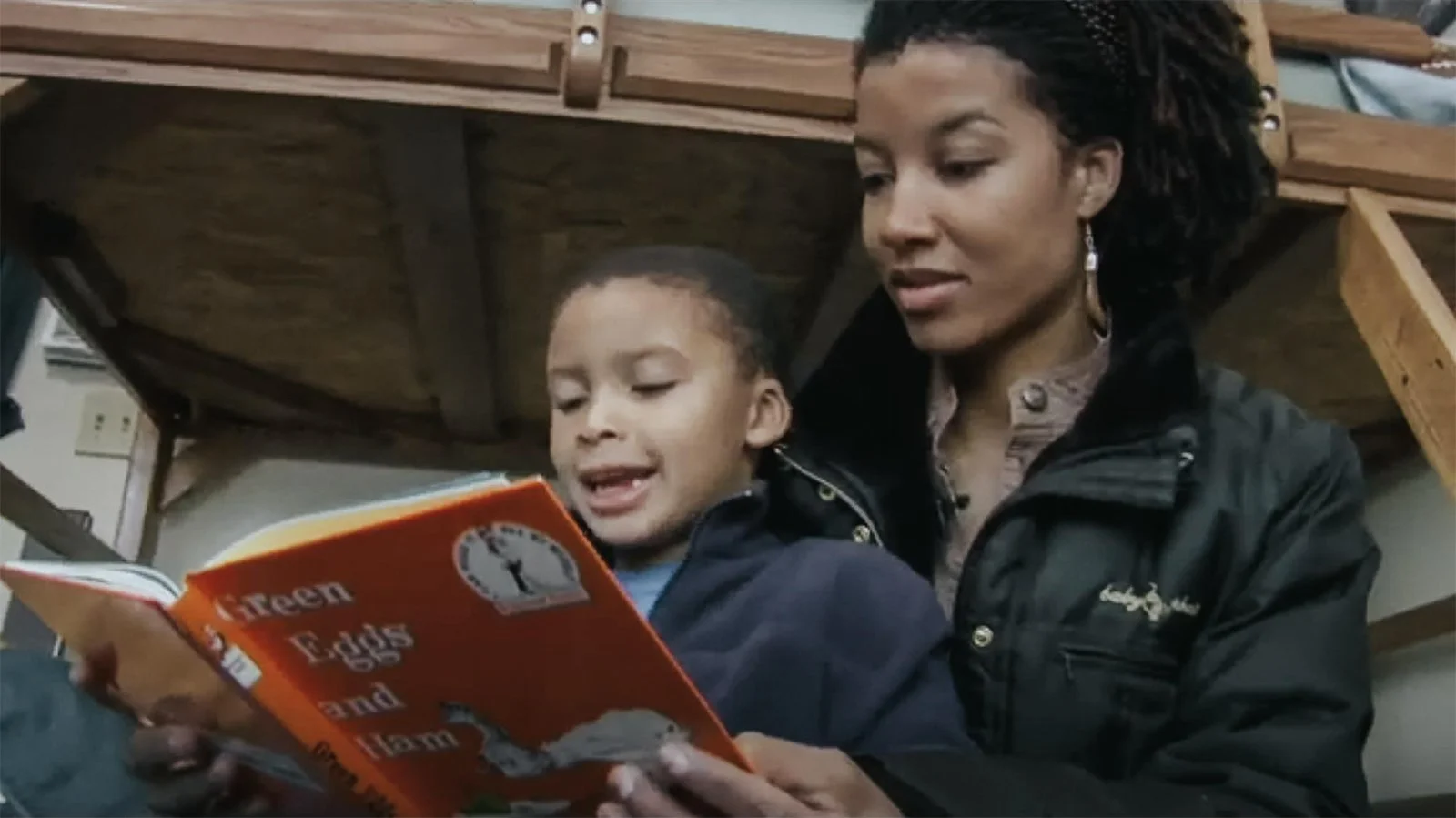
Above: The changing face of homelessness in Los Angeles – more than half of the Mission's guests were women, children, and families. Families like Sarah and Elijah.
We redesigned the program around them. Instead of sponsoring a meal, donors supported a representative woman and child. Each month, they'd receive the story of a different family, with a representative photo to protect privacy. And at the start of each year, donors received a calendar with those faces on it – so that every month, they'd see the changing face of the people their generosity was helping.
The results came fast. Fulfillment jumped more than 25% – no small thing in the days when a monthly gift often meant remembering to mail a check. Retention climbed. And the program that had been stuck for years started growing again.
Nothing about the Mission's work had changed. We were still providing meals and beds. The only thing that changed was that we stopped asking donors to fund the meal, and started inviting them to change a life.
💡 Takeaway: When you design your best offer for recurring giving, focus on outcomes, not inputs – that's what donors are actually funding. Whatever your cause, don't object-ify your offer. Humanize it.
Until next week… Surf's Up! 🌊
- Dave
P.S. This is the heart of what we do. If your organization has an established base of recurring donors and you're serious about growing the value of that program, I'd love to help you specifically. Our Sustainable Giving Growth Advisory is a deep-dive assessment and roadmap built around your program and your context. Learn more and see if it's a fit at sustainablegiving.org/grow.