
Your Mission Shouldn't Change. Your Model Must.
Think of a retailer that pioneered an entirely new way of selling.
While its competitors each specialized in one kind of product – hardware here, clothing there, appliances down the street – this company did something no one else had. It put everything under one roof. Unmatched selection. Unbeatable breadth. If you wanted it, they had it, and they could get it to your door.
It crushed the specialists on the two things customers cared about most: choice and convenience. It reshaped how an entire nation shopped.
You might be thinking of Amazon.
I'm talking about Sears.
A century before Jeff Bezos shipped his first book, Sears, Roebuck and Co. built the original "everything store" on the back of its legendary mail-order catalog. From a farmhouse in rural America, you could order tools, dresses, bicycles – even an entire build-it-yourself house – and have it delivered to your door. For decades, Sears was the largest, most dominant retailer in the country.
And then it all but vanished.
Here's the part that should give every leader pause: in 1993, Sears shut down the very catalog that built it – right as the internet was about to make ordering everything from a screen the biggest business opportunity of the next thirty years. Amazon would go on to become one of the most valuable companies on the planet, built on essentially the same idea Sears invented and then walked away from.
Sears didn't lose its way because its mission was wrong. It lost its way because it confused its mission with its model.
As leaders, I think we all need to learn this, and then continually remind ourselves – our model is not our mission.
Your Model is Not Your Mission
Sears isn't alone. We all know of organizations that became great, then faltered from greatness.
Apple lost its way in the late 1980s, after Steve Jobs left (the first time).
Disney animation lost its magic in the late 1990s, going over a decade without a hit film.
In the 2000s, Blockbuster Video infamously fell from the undisputed leader in video rentals to bankruptcy in less than ten years.
What do Sears, Apple, Disney, and Blockbuster have to do with leading an effective and thriving charity in the 21st century?
A lot.
Two of these companies – Apple and Disney – found their way back to greatness. The others failed so completely that they are effectively gone.
Why did Blockbuster, like Sears, ultimately fail?
I believe it's because leadership made one fundamental mistake – the same one Sears made, and the same one every organization and leader is prone to making, for-profit businesses and nonprofit causes alike. Left uncorrected, this mistake eventually leads to an organization's downfall – or worse, its irrelevance.
Blockbuster confused its model with its mission.
Your Mission and Your Model Are Two Different Things
Don't mistake your mission, which should be timeless and unchanging, with your model, which is how you accomplish that mission. Your mission shouldn't change. But your model will have to change over time if you want to keep achieving your mission at scale.
Blockbuster completely missed the shift from in-store rental to DVDs-by-mail, and later the move to streaming.
Let's look at a couple of examples from the nonprofit sector.
Charity: water set out with a clear mission: to bring clean and safe drinking water to people in developing countries. That mission hasn't changed – but their model has evolved dramatically. From early one-time campaigns to today's robust sustainable giving program, The Spring, charity: water has shifted toward a subscription-style approach to funding the mission. They've also embraced technology to increase transparency, tracking wells in real time and proving impact to donors. It's a case study in adapting your model to better scale your mission.
🎙️ On the Sustainable Giving Podcast, I sat down with Brian Seay to explore how charity: water designs experiences that create lifelong donors. Listen here: How charity: water Designs Experiences That Create Lifelong Donors.
Similarly, Compassion International has remained anchored to its mission – releasing children from poverty in Jesus' name – while continually evolving how it carries it out. What began as a simple child sponsorship model has grown into a holistic child development program delivered through local churches around the world. Over time, Compassion has modernized its communications, adapted its programs to local contexts, and expanded how it engages donors – all without compromising its core mission. It's a powerful example of remaining mission-faithful while staying model-flexible.
💡 Takeaway: Great organizations adapt their models without compromising their mission. Charity: water and Compassion International both held fast to their purpose while evolving how they fund, deliver, and scale their impact.
The Graveyards of History
Long-term effectiveness requires clarity of mission and flexibility of model. Why? Because the graveyards of history are littered with organizations that pioneered one way of doing things but failed to transition to the next.
Every organization, every institution, every person, is somewhere on the following lifecycle curve:
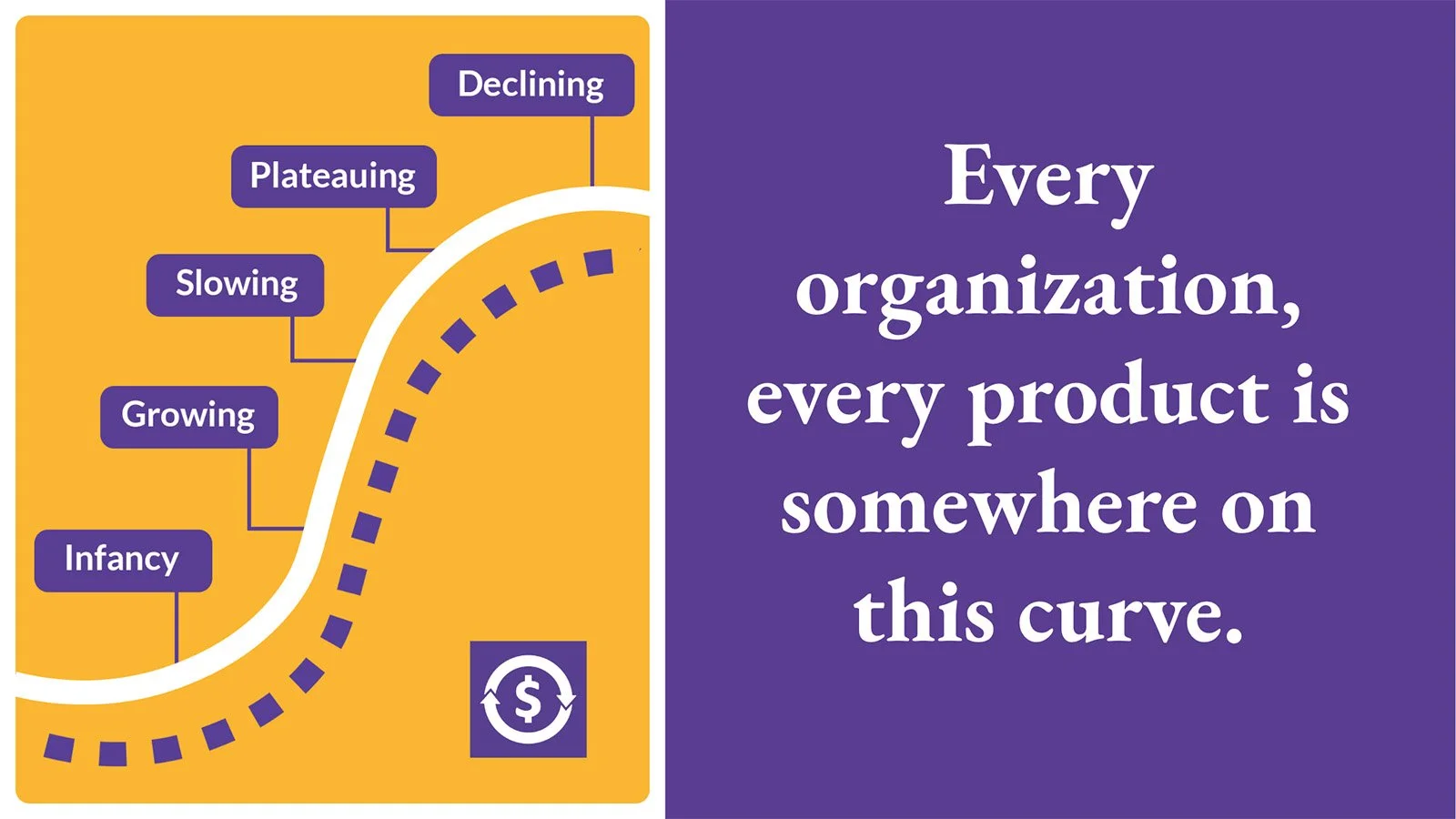
Above: All organizations and all initiatives sit somewhere on a curve from infancy to growth, followed by slowing, eventual plateauing, and then decline. But this doesn't have to be the end of the story.
We're either in infancy, growing, slowing, plateauing, or declining.
That may sound harsh, but it's an immutable law – something like a fourth law of thermodynamics for organizational life. Every organization will eventually slow, plateau, and decline.
But the inevitable decline of our model doesn't have to be the end of the story. It doesn't have to be the end of our mission.
This is why innovation matters so much. Innovation helps us create new S-curves, new models, and new ways of accomplishing the mission.
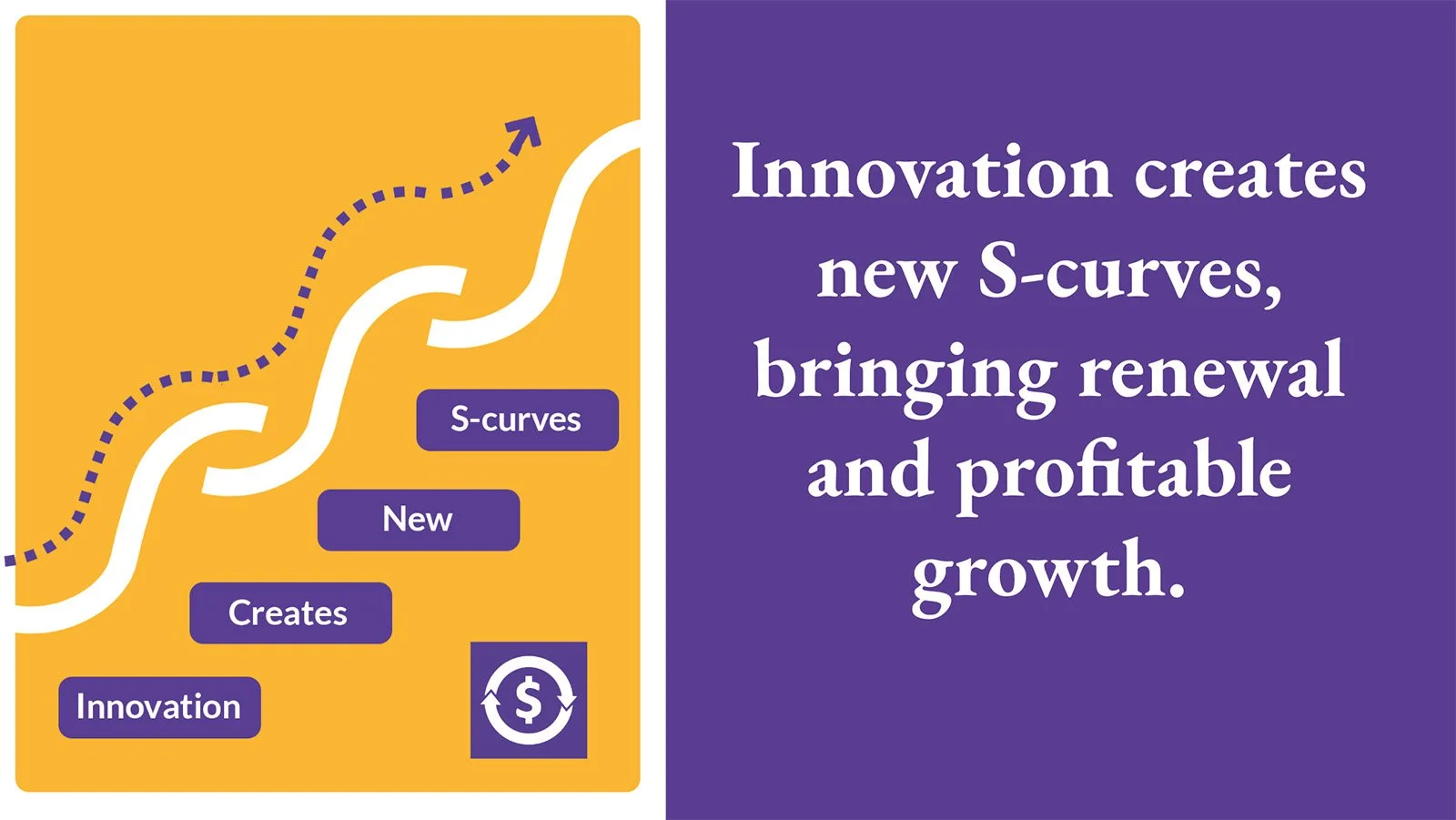
Above: Innovation enables organizations to identify and create new models that lead to renewal and profitable growth.
New models lead to new S-curves and healthy growth.
Apple released the iMac in 1998, revitalizing the company's image and product line, and paving the way for entirely new models in computing, in iPods, and eventually the iPhone. Today, Apple is valued at more than $4 trillion. Yes, that's trillion with a "T." Talk about new S-curves.
Disney first partnered with, then purchased Pixar in 2006, revitalizing Disney animation – the heart of the company – in the process. In his memoir, The Ride of a Lifetime, CEO Bob Iger writes that boldly reinventing the model for making animated films was a pivotal moment in turning the company around.
Blockbuster, on the other hand, was so fixated on its once-innovative model – brick-and-mortar superstores, inventory systems, and sales of physical VHS tapes and DVDs – that when it was offered the chance to buy an upstart called Netflix for $50 million, it laughed the founders out of the building.
Blockbuster confused its mission – delivering entertainment with a consistent experience – with the model that had served it so well in the late 1980s and 1990s. That confusion led to its downfall, as it missed the DVD-by-mail and streaming revolutions.
Today, Netflix is worth roughly $300 billion, and Blockbuster is out of business.
A while back, I had the privilege of interviewing Tom Beck, one of the early operators at Blockbuster and now an executive at Compassion International. (For several years I co-founded and co-hosted the Purpose & Profit Podcast, exploring the surprising ideas at the intersection of causes and brands. After six seasons, we wrapped the show last year.)
Tom opened the third-ever Blockbuster store, so he was there at the very beginning. In just three years, his group opened around 125 stores. I was fascinated to hear what lessons we could draw from the cautionary tale of Blockbuster – and from Compassion International, one of the world's largest charities.
It was a fascinating conversation about the lessons Tom learned across ventures like Blockbuster, Boston Market, Einstein Bagels, and eventually Compassion International. You can listen here: Leadership Lessons from Blockbuster, Boston Market, and Compassion International.
💡 Takeaway: Every organization, every model, eventually hits a plateau – but decline doesn't have to be inevitable. Those who thrive over time are willing to reinvent their model to stay true to their mission.
What about your organization? Are you trying to accomplish a timeless mission with a model that's fraying at the edges?
Sustainable Recurring Giving – a New Model for Funding the Mission
There's a renaissance in funding models underway – quietly at first, and now taking the sector by storm. Sustainable recurring giving is leading a shift from periodic one-time donations to consistent, recurring gifts.
Charity: water and Compassion International both fuel the majority of their mission through sustainable, recurring giving. And thanks to the subscription economy, more charities have access to building resilient recurring giving programs than at any point in history.
I'm on a mission to wave this flag in our sector. My book, The Rise of Sustainable Giving, points to the beginning of a bright new opportunity for the 1.1 million charities that have historically been left behind.
Until next week… Surf's Up! 🌊
– Dave