
Make a Decision, Then Make it Right
Leadership is making decisions – usually with imperfect information, often without much time. The most effective leaders make a lot of decisions, and they worry less than you’d think about being right. That can sound reckless until you understand why.
But can I be honest with you?
Decision-making is one of the most fatiguing things I do. Some days I get stuck in my own head. I can turn even a simple decision over and over, thinking through every possible outcome, and then every outcome those outcomes might lead to, and then where those lead. It can easily devolve into analysis paralysis fast.
Other days, deciding feels like a superpower. Usually that’s when we’re advising a charity, or an organization that serves charities, on how to grow more sustainable giving. It’s an area of deep expertise and conviction, and I've honed my judgment through practice, so I can move quickly and speak with confidence about where to go next.
So I’m not always an over-thinker. But the decisions that wear me down are the ones where I’m the one who has to live with the outcome.
In 2022, I left security and certainty behind to found what has become The Center for Sustainable Giving.
That sentence sounds purposeful, like there was a detailed step-by-step plan all along. There wasn’t. There was conviction and an overall direction. There were also a million questions.
Still, I knew enough. So I left a senior executive role at one of the nation’s leading marketing agencies, where I worked with some of the world's largest and most impactful nonprofits. Leaving secure employment to start from scratch isn't a small decision. I didn’t know where it would lead. I prepared as much as I could, fiscally, mentally, and strategically, and then made the decision.
Launching The Center was – and still is – a constant flow of decisions. I once described it to a friend like a game of chess where I wish I could see six moves ahead. Every decision opened onto a range of outcomes, which presented new decisions, which opened onto new outcomes. I wanted to see all of it before I made the next first move.
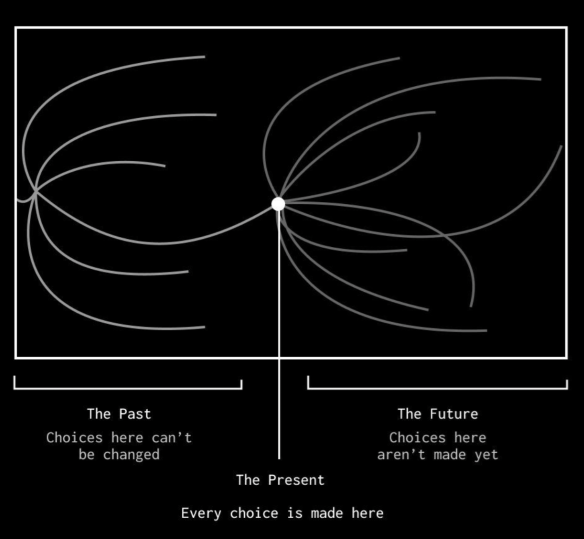
Above: Decisions are made in the present. You can’t change the past. The future is full of choices you can’t yet make.
But none of us can see the path perfectly, even two or three branches out. We have today, what we know, and the choice in front of us. Waiting for perfect information would mean never deciding.
Make a Decision, Then Make It Right
The unlock came from my friend Rory Starks.
Rory is one of the most impactful leaders I’ve ever worked with. He helped build organizations like World Vision and Food for the Hungry before he and I spent nearly two decades together at the agency Masterworks. One day he told me something I’ve never forgotten:
“Dave, just make a decision, and then make it right.”
For someone wired to think through every possibility before committing, that was freeing. I could make a decision, full stop. And if I didn’t like it or wanted to tweak it, I could make another decision and make it right.
It also surfaced something I’d been missing: what feels like one big decision is usually a series of small ones. Often all you need is to make the next decision, not solve the whole decision.
That was the shift.
There’s a structure underneath Rory’s advice, and Jeff Bezos has a framework that names it well.
One-Way and Two-Way Door Decisions
During his time at Amazon, Jeff Bezos and his leadership team built one of the most effective business cultures of the modern era, using several frameworks.
One such framework was the idea of one-way door decisions and two-way door decisions. One-way door decisions are so big, so consequential, and so hard to reverse that once you go through that door, it will be very difficult, if not impossible, to come back.
On the other hand, two-way door decisions can be made and then changed without huge consequences. You can walk through the door, take a look around, and decide whether to continue on from there, or go back.
Here’s the powerful insight – most decisions are two-way door decisions.
Bezos says, “Most choices are like walking through a door. If you do not like what is on the other side, you can turn around and go back.”
Watch: Jeff Bezos on one-way and two-way door decisions
💡 Takeaway: Rare few decisions really are one-way doors – so consequential and so hard to reverse that the job of a leader is to slow down, weigh the options, and study the outcomes. But most decisions aren’t like that. So pick a door, walk through, and spend a little time on the other side. If it’s wrong, come back and pick another.
An Early Decision for The Center for Sustainable Giving
One of my first big decisions at The Center was a two-way door, though it didn’t feel like one at the time.
When I first founded what would become The Center for Sustainable Giving, I had several ideas about what I wanted to build, and for whom.
But knowing I might get stuck on one particular conviction, I started thinking of decisions as hypotheses to test. Instead of deciding what would happen before we really knew, we proposed a hypothesis we could then test.
Coming from a career serving charities, I felt the core of our work would include helping them, but I also wanted to work with companies.
After all, I had spent nearly 20 years inside a company serving nonprofits, and wanting to focus on what was happening with the subscription economy and recurring revenue, I thought that in addition to helping charities raise more recurring giving, we could also help subscription-oriented companies build better subscriptions.
That hypothesis turned out to be wrong.
We did a little of that early work, and it was interesting, but where we found traction was helping companies that help charities grow recurring revenue. In this way, we either worked with charities directly to help them grow recurring giving, or we helped the companies that helped them grow recurring giving. It was totally aligned, and today, about 20% of the organizations we work with are businesses that help nonprofits grow recurring giving.
So today, alongside the many charities we serve, we do work with businesses too – just not in the way I first imagined. I walked through a door, didn’t love the room, and made another decision.
You only get better at decisions by making them. Deciding is a muscle. The leaders who are good at it aren’t the ones who found a way to be right every time. They’re the ones who’ve simply decided more often.
Know Yourself
Some of you read all of that about decision fatigue and can’t relate. You’re wired to decide. You’re happy to make a call, and to make a lot of them.
What’s important is understanding your tendencies. I know there are going to be times I need to accelerate and make more and smaller decisions. You may need to slow down and invite input.
A tool that’s helped me here is the Six Types of Working Genius. (I’ve written before about Working Genius as the tool that changed how I lead.)
The premise is that there are six kinds of work, and each of us is naturally gifted at and energized by two of them. Here’s a quick primer on the types of Working Genius:
Wonder – asking questions
Invention – generating possible solutions
Discernment – good judgment and gut feel
Galvanizing – getting people to act
Enablement – responding to needs
Tenacity – getting things done
My top two geniuses are Wonder and Discernment.
Wonder keeps me comfortable sitting with possibilities and asking big questions. Discernment wants to cut through the clutter and say, “This is what matters, now.” Together they can be a powerful loop.
Wonder and Discernment can also become a rut: I generate a new possibility, analyze where it leads, generate another, and never actually decide. I can also appear to lack conviction in a specific direction or decision, because I can always imagine “another way.”
Contrast my Wonder and Discernment with a leader whose geniuses are Galvanizing and Tenacity. They love to move people to action and to get stuff done. Where my risk might be in getting stuck in possibilities and evaluating them, the Galvanizing/Tenacity leader’s risk is that they don’t slow down long enough to ask the right questions. They can move fast toward the wrong thing.
💡 Takeaway: Patrick Lencioni, lead creator of the Working Genius model, says it best – “The best type of leader is a self-aware one.” Know yourself, and you’ll know whether your next improvement is decision velocity or decision quality.
Life Is Not a Game of Chess
Let’s end where we started.
Life is not a game of chess, where if you study the board long enough you can foresee every outcome and decide with perfect, objective data. You don’t get that clarity, and waiting for it is its own decision.
So remember three things:
Most decisions are two-way doors, even though we treat them like one-way doors. Make a decision, and make it right.
Big decisions are usually a series of small, next decisions. Make the smallest needed next decision to keep moving forward.
The kind of decision that trips you up depends on how you’re wired. Know yourself, and correct for where you tend to err.
When I decided to leave my executive position at the agency, there was no way to go back to exactly what I had. That door was really one-way.
But the beautiful thing about that was there were a thousand new doors ahead. While I couldn’t return to what was, I could make a decision, and then make it right.
So, what decision are you facing right now? Is it a one-way door, or a two-way door?
Statistically speaking, it’s probably a two-way door.
Only you can decide.
So make a decision, and then make it right.
Until next week… Surf’s Up! 🌊
- Dave